Kovelyrado
Luma Deck
Luma Deck
Couldn't load pickup availability
1. Problem Statement
After trying the first Kotlin materials, many learners need more than a short introduction. They may understand variables or functions in isolation, but still feel unsure when several ideas appear in the same task. Code can start to feel fragmented when examples do not show how one concept connects to another. A learner may also need more repetition, not through random drills, but through thoughtful tasks that build from one idea to the next. Luma Deck responds to this moment by offering a wider, more structured place to continue.
2. Solution
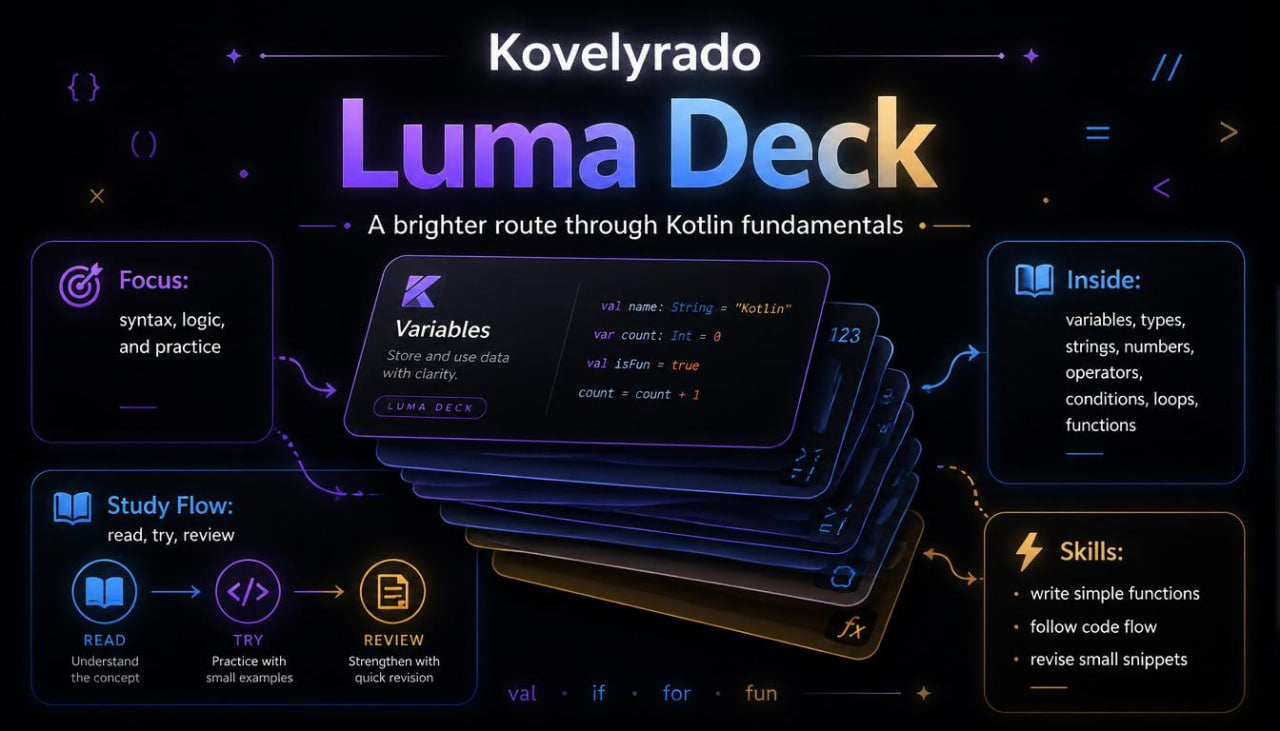
Luma Deck gives learners a guided Kotlin path built around readable explanations and practical exercises. The course moves through core language topics in a steady order, so each module has a reason to be there. Learners can study syntax, logic, and small program structure without being pushed into oversized projects too early. The materials are written to make each concept feel connected to the next one. This tier helps learners build a stronger study base through organized examples, tasks, and review notes.
3. What’s Inside
Luma Deck includes a full set of Kotlin learning materials arranged as a guided deck of modules. The course begins with Kotlin syntax refreshers, then moves into variables, data types, strings, numbers, operators, conditions, loops, and simple functions. Each topic includes explanation notes, code samples, small assignments, and reflection prompts that invite learners to think about why the code behaves a certain way.
The tier also includes practice pages for reading code line by line. These pages are useful for learners who do not only want to write code, but also want to understand what existing snippets are doing. You will find short debugging-style activities, naming exercises, logic puzzles, and small rewrite tasks where learners adjust code to make it cleaner and more readable.
Luma Deck also contains a study map that shows how the modules connect. This helps learners move through the materials without guessing what to study next. The course is not built around loud claims or pressure. It is shaped as a careful learning route for people who want structure, repetition, and practical Kotlin work.
4. Who Is This For?
Luma Deck is for learners who already explored a small Kotlin introduction and want a fuller starting path. It fits people who prefer organized notes, steady exercises, and examples that do not skip too many steps. It is also suitable for learners returning to Kotlin after a pause and looking for a grounded way to rebuild their understanding.
5. What You Will Learn
- How Kotlin variables, values, and types work together
- How to read and write basic conditional logic
- How loops support repeated actions in code
- How simple functions are created and used
- How to follow Kotlin snippets from top to bottom
- How to spot small code issues and revise them
- How to organize short Kotlin tasks with cleaner naming
- How to connect separate syntax ideas inside one exercise
6. 30-Day Refund Note
Paid Kovelyrado course tiers include a 30-day refund window according to the store policy. If the materials do not match your learning needs, you may contact Kovelyrado within that period for review under the stated refund terms.
Self-paced learning overview
- 📁 Digital file available after purchase
- 📚 Long-term availability
- 🔒 Secure checkout
- 🗓️ Content updated in 2026
Can I start with any tier?
Can I start with any tier?
Yes. Each tier is arranged as a separate Kotlin learning path, so you can choose the one that matches your current study needs.
Are the materials only for beginners?
Are the materials only for beginners?
No. The collection is planned for different levels, from first Kotlin steps to more structured coding practice.
What happens after I choose a tier?
What happens after I choose a tier?
You receive the relevant course materials, modules, tasks, and study notes connected to that tier.
Share